
People searching for the Mindful Awareness Research Center are often looking for reliable meditation instruction, scientific context, free guided practices, or information about UCLA’s mindfulness programs. The center has helped connect contemplative practice with academic research and public education, making mindfulness more approachable for students, professionals, families, and beginners.
That interest reflects a broader question: How can mindfulness move beyond an abstract wellness idea and become a practical daily habit? This guide explains the center’s purpose, its current relationship with UCLA Mindful, what its research can and cannot tell us, and how you can develop a grounded mindfulness routine.
Mindfulness Meditation Hub is an independent educational resource, and this article does not claim an affiliation with UCLA. Our website provides beginner-friendly meditation guides, mindfulness exercises, guided practices, and educational resources for people seeking greater calm, clarity, and emotional balance.
What Is the Mindful Awareness Research Center?
The center, commonly known as MARC, is based within UCLA’s Jane and Terry Semel Institute for Neuroscience and Human Behavior. Its stated mission is to foster mindful awareness across the lifespan through education and research that support well-being and a more compassionate society.
UCLA reports that the program has conducted mindfulness research and offered educational programs since 2006. In 2023, its work became more clearly divided. MARC at the Semel Institute retained its primary research focus, while UCLA Mindful at UCLA Health began emphasizing mindfulness education for the UCLA community and the wider public.
This distinction is important because older websites and articles may use MARC and UCLA Mindful almost interchangeably. Today, readers can view MARC as the research-focused program and UCLA Mindful as the main educational platform.
How the Center Connects Research and Practice
The Mindful Awareness Research Center has examined mindfulness broadly as well as its signature Mindful Awareness Practices, commonly called MAPs.
UCLA’s research pages describe studies involving community residents, schoolchildren, and English- and Spanish-speaking adults. These studies have explored areas such as perceived stress, self-compassion, depressive symptoms, attention, and executive functioning.
Research in this field asks practical questions:
- Can structured mindfulness training help people recognize stress earlier?
- Can regular practice support attention and emotional regulation?
- Can mindfulness programs be adapted for different age groups?
- Can courses work effectively across languages and communities?
- How much practice is necessary before participants notice changes?
These are valuable questions. However, responsible interpretation is essential.
A promising study does not prove that one meditation method will work for everyone. Sample size, participant characteristics, program length, comparison groups, and study design all affect the reliability and relevance of a conclusion.
What Does Evidence-Based Mindfulness Mean?
Evidence-based mindfulness should not mean making dramatic health promises. Instead, it should involve combining the strongest available research with qualified instruction, personal circumstances, realistic expectations, and appropriate professional care.
The National Center for Complementary and Integrative Health reports that mindfulness meditation programs have shown moderate evidence of improving anxiety and depression in some studies. However, evidence for many other outcomes remains mixed, limited, or dependent on the population being studied.
A trustworthy mindfulness resource should:
- Separate scientific findings from marketing language
- Avoid presenting meditation as a cure
- Explain who participated in a study
- Acknowledge uncertainty and research limitations
- Encourage professional care for serious symptoms
- Offer practices that can be modified for accessibility and comfort
This balanced approach protects practitioners while preserving what mindfulness can teach effectively: attention, awareness, patience, compassion, and a less automatic relationship with thoughts.
Educational Programs and Public Resources
UCLA Mindful currently offers mindfulness classes, workshops, retreats, guided meditations, weekly sessions, and an app. Its classes are available to members of the public as well as UCLA students, staff, and faculty, with both online and in-person learning opportunities.
The organization’s free meditation library includes introductory practices such as:
- Breathing meditation
- Body scan meditation
- Breath, sound, and body awareness
- Loving-kindness meditation
- Practices for working with difficult experiences
- Short exercises for calm and concentration
Some resources are also available in multiple languages, making the instruction accessible to a broader audience.
Why Free Guided Meditation Matters
Many beginners stop meditating because they are unsure what to do. A guided recording provides a clear voice, a defined session length, and a simple object of attention.
This structure can reduce uncertainty and help new practitioners understand that meditation does not require eliminating every thought.
Free recordings also allow people to explore different meditation techniques before enrolling in a course. One person may connect with breath awareness, while another may prefer a body scan, mindful movement, sound meditation, or compassion practice.
However, recorded instruction is only one pathway. Some people benefit from a structured class, teacher feedback, community support, or personalized guidance. The right level of support depends on your experience, goals, health history, and response to the practice.
What the Mindful Awareness Research Center Teaches About Daily Practice
One of the most useful lessons is that mindfulness can be trained. It is not a personality trait reserved for people who are naturally peaceful or emotionally composed.
Mindful awareness research center practice involves noticing present experience and returning attention with less judgment whenever the mind wanders. You can apply that principle without creating a complicated routine.
Begin With Five Minutes
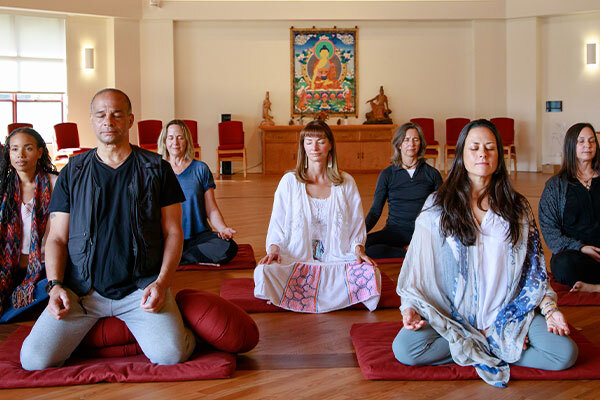
Choose a regular time and sit in a comfortable, stable position. Let your eyes close or soften.
Notice the physical sensation of breathing for five minutes. You do not have to make the breath deeper or slower. Simply observe the inhale, the exhale, and the moments when your attention moves elsewhere.
When your mind wanders, gently return to the breath. That return is not evidence that you failed. It is the practice itself.
Choose a Clear Attention Anchor
An anchor gives your attention somewhere specific to return. Common options include:
- Air moving through the nostrils
- The rise and fall of the abdomen
- Sounds in the room
- Sensations in the hands or feet
- Contact between your body and the chair
- The movement of your feet while walking
No single anchor is best for everyone. Choose one that feels steady, accessible, and comfortable.
Name Distractions Gently
When attention wanders, use a quiet mental label such as:
- “Thinking”
- “Planning”
- “Remembering”
- “Worrying”
- “Hearing”
- “Feeling”
The label should not become a criticism. It is simply a brief recognition that helps you step away from the mental story and return to present experience.
Finish With a Check-In
Before ending the session, notice your body, mood, breathing, and energy.
Ask yourself:
- What feels different?
- What feels unchanged?
- Did anything feel uncomfortable?
- What helped me remain present?
- What would make the next session easier?
This reflection helps you learn from your experience rather than judging the meditation as successful or unsuccessful.
A Seven-Day Mindful Awareness Plan
You do not need to meditate for an hour to begin building awareness. Use this seven-day plan to explore several simple practices.
Day 1: One-Minute Breathing Pause
Take ten natural breaths. Notice where each breath feels most obvious in your body.
Day 2: Five-Minute Body Scan
Move your attention slowly from your feet toward your face. Notice warmth, pressure, tingling, tightness, or the absence of a clear sensation.
Day 3: Mindful Walking
Walk slowly for five minutes without checking your phone. Feel each foot lift, move forward, and touch the ground.
Day 4: Sound Awareness
Listen for nearby and distant sounds. Notice how each sound begins, changes, and eventually disappears.
Day 5: Observing Thoughts
Sit quietly and notice thoughts when they appear. Label them gently, then return to your breathing without arguing with your mind.
Day 6: Loving-Kindness Practice
Silently repeat a supportive phrase such as, “May I meet this moment with patience.” You can then offer the same wish to someone else.
Day 7: Review Your Experience
Write down which practice felt most natural, which felt difficult, and which one you are willing to repeat three times during the following week.
Consistency matters more than duration. A realistic five-minute routine practiced several times each week is often more sustainable than an ambitious plan that quickly becomes overwhelming.
Mindfulness Research Without Exaggerated Claims
Mindfulness is frequently marketed as a solution for nearly every emotional, physical, and professional problem. Research does not support treating it as a universal cure.
Meditation may support stress management, emotional awareness, concentration, and general well-being for some people. Results can vary considerably, however, and meditation should not replace medical care, psychotherapy, medication, or other treatment recommended by a qualified professional.
Meditation practices are generally considered low risk, but negative experiences can occur. NCCIH notes that some practitioners report experiences such as anxiety or depression during or after meditation.
Stop or adjust the practice when it feels overwhelming. Options include:
- Shortening the meditation
- Keeping your eyes open
- Practicing mindful walking
- Focusing on external sounds
- Using grounding exercises
- Working with a qualified teacher
A safe practice respects your limits instead of forcing you to remain with an experience that feels destabilizing.
How Mindfulness Meditation Hub Supports Your Journey
Research institutions help test programs, expand scientific knowledge, and improve public understanding. Independent educational platforms can complement that work by turning broad mindfulness principles into accessible everyday instructions.
At Mindfulness Meditation Hub, we provide practical resources for beginners and experienced practitioners who want to understand meditation, establish consistent routines, and incorporate mindfulness into everyday life.
Our resources can help you:
- Compare meditation techniques
- Create a home meditation practice
- Learn breathing and grounding exercises
- Explore guided meditation
- Understand body scan practices
- Find mindfulness activities for families
- Prepare for a meditation or wellness retreat
- Develop a realistic self-care routine
Our role is educational. We do not diagnose health conditions or replace licensed medical or mental health care. Instead, we help readers explore mindfulness with greater clarity, practical direction, and realistic expectations.
Related Topics
- Teaching Mindfulness: Transform Lives with Simple Practices
- Mindfulness Tip: 10 Simple Habits for a Calmer Mind
- Emotional Mindfulness: Master Your Emotions with Ease
- Mindfulness Journey: Transform Your Life with Inner Peace
- Mindfulness Emotion: Transform Your Emotional Well-Being
- Mindfulness and Stress Management: Your Path to Lasting Calm
- Mindfulness Strategy: Transform Stress Into Lasting Calm
- Mindfulness for Stress and Anxiety: Reclaim Calm Naturally
- What Is Mindfulness Meditation? Unlock Calm, Focus & Joy
- Mindfulness in Work: Boost Focus, Reduce Stress & Thrive