
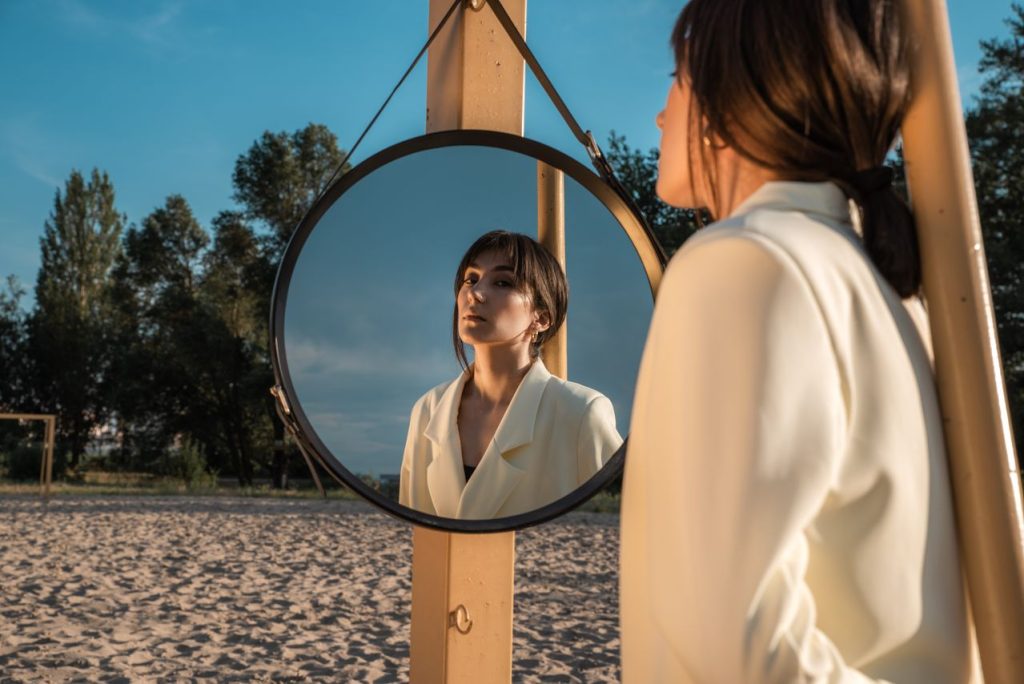
Discover mirror self reflection as a mindful practice for self-awareness, confidence, emotional clarity, and deeper personal growth in everyday life.Why Looking in the Mirror Can Become a Mindfulness Practice
Most of us look in a mirror dozens of times without really seeing ourselves. We check our hair, adjust our clothes, brush our teeth, or prepare for the day. The moment is usually practical and brief.
But what if a mirror could become more than a tool for checking your appearance?
Mirror self reflection is a mindfulness practice that uses intentional eye contact with your own reflection to encourage greater self-awareness, emotional honesty, and compassion. Rather than focusing on whether you look attractive, tired, successful, or different from yesterday, the practice invites you to simply notice yourself as you are.
This can feel surprisingly powerful.
For some people, looking into their own eyes creates a sense of calm. For others, it may initially feel uncomfortable or unfamiliar. Both responses can provide useful information about how we relate to ourselves.
At MindfulnessMeditationHub.com, we provide practical resources, exercises, and mindfulness techniques to help you explore practices like this and incorporate them into everyday life. Whether you’re new to meditation or have practiced for years, our resources are designed to support your personal mindfulness journey.
What Is Mirror Self Reflection?
At its simplest, mirror self reflection involves sitting or standing comfortably in front of a mirror and deliberately observing your reflection without immediately judging what you see.
Instead of asking, “Do I look good?” you might ask:
- What am I feeling right now?
- What thoughts appear when I look at myself?
- Can I observe myself without criticism?
- What sensations do I notice in my body?
- Can I meet my own gaze with kindness?
The goal isn’t to create a perfect image of yourself. It is to develop a more mindful relationship with the person looking back at you.
This makes the practice closely connected with self-awareness, mindfulness meditation, self-compassion, emotional awareness, and reflective practices.
Unlike ordinary mirror use, the emphasis isn’t primarily on appearance. The emphasis is on attention.

How Mirror Self Reflection Supports Mindfulness
Mindfulness involves intentionally paying attention to the present moment with openness rather than automatically reacting to every thought or feeling.
A mirror can provide a surprisingly effective focal point for this process.
When you sit quietly and look at your reflection, you may notice thoughts such as:
“I look exhausted.”
“I don’t like this feature.”
“I should have accomplished more by now.”
“Why do I feel uncomfortable doing this?”
Instead of following these thoughts, mindfulness teaches you to notice them.
You don’t have to argue with them or believe them.
You can simply recognize, “That is a thought,” and return your attention to your breathing, your eyes, and the present moment.
Over time, this can help create distance between what you experience and how you automatically respond to it.
The Difference Between Self-Reflection and Self-Criticism
One of the most important distinctions in this practice is the difference between reflection and judgment.
Self-criticism often sounds like:
- “I don’t look good enough.”
- “I should be more successful.”
- “I always make mistakes.”
- “Something is wrong with me.”
Self-reflection sounds different:
- “I’m noticing insecurity right now.”
- “I feel tired today.”
- “I’m having a difficult emotion.”
- “I notice that I’m judging myself.”
The second approach creates space.
You’re not pretending everything is perfect. Instead, you’re observing your experience without immediately turning an observation into an attack on yourself.
That shift can make a mindfulness practice more meaningful and sustainable.
Potential Benefits of Looking at Yourself Mindfully
A consistent reflective practice may offer several personal benefits when approached gently and realistically.
Greater Self-Awareness
Spending uninterrupted time observing yourself can reveal patterns that are easy to overlook during a busy day.
You may become more aware of recurring emotions, negative self-talk, stress responses, or habits of comparison.
This awareness doesn’t automatically solve a problem, but it gives you a clearer starting point.
More Self-Compassion
Many people speak to themselves more harshly than they would speak to a friend.
A mindful mirror exercise can become an opportunity to practice a different internal voice.
Try looking at yourself and saying:
“I’m doing my best today.”
“I can be patient with myself.”
“I don’t have to be perfect to be worthy of kindness.”
The words themselves aren’t magic. Their value comes from practicing a more compassionate way of relating to yourself.
Improved Emotional Awareness
Sometimes we know that something feels wrong without understanding exactly what we’re experiencing.
Quiet observation can help you identify emotions more clearly.
You might realize that what you called “stress” is actually disappointment, loneliness, frustration, fear, or exhaustion.
Naming an emotion can make it easier to respond thoughtfully rather than react automatically.
A Stronger Connection With the Present Moment
The mirror provides a physical anchor for attention.
Rather than replaying yesterday or planning tomorrow, you can focus on what is happening right now: your breathing, facial expression, posture, thoughts, and sensations.
This makes the exercise particularly useful as a simple mindfulness activity.

A Simple 5-Minute Mirror Practice
You don’t need special equipment or a complicated routine.
Follow these steps to get started.
1. Choose a Quiet Space
Find a place where you can sit comfortably without being interrupted.
Use a mirror that allows you to see your face clearly. Natural lighting can be comfortable, but there is no requirement for a particular type of mirror or environment.
2. Settle Your Breathing
Take several slow, comfortable breaths.
Don’t force your breathing to become unusually deep. Simply notice the natural rhythm of inhaling and exhaling.
Let your shoulders relax.
3. Look at Your Reflection
Gently look toward your own eyes.
You don’t need to stare intensely. If direct eye contact feels uncomfortable, soften your gaze or briefly look at other parts of your face.
The purpose is awareness, not performance.
4. Notice Your Immediate Reaction
Pay attention to what happens internally.
Maybe you feel relaxed.
Maybe you become self-conscious.
Maybe critical thoughts appear.
Maybe you want to look away.
Whatever happens, notice it without labeling the experience as good or bad.
5. Practice Nonjudgmental Observation
When a thought appears, acknowledge it and return to the present.
For example:
“I’m noticing that I’m judging my appearance.”
Then breathe.
You don’t have to replace every negative thought with a positive thought. Learning to observe thoughts without automatically accepting them is already a meaningful mindfulness skill.
6. End With Compassion
Before finishing, take one final breath and offer yourself a simple statement:
“May I treat myself with patience today.”
Then gently move on with your day.
What If Looking in the Mirror Feels Uncomfortable?
Feeling uncomfortable doesn’t necessarily mean you’re doing the practice incorrectly.
For some people, sustained self-observation can bring attention to insecurities, difficult memories, body-image concerns, or emotions that are normally pushed aside.
If this happens, reduce the duration.
Start with 30 seconds instead of five minutes. You can also practice with your eyes softly focused rather than maintaining direct eye contact.
Most importantly, you don’t need to force yourself through significant distress.
Mindfulness is not about enduring discomfort simply to prove that you can. A healthy practice should include choice, boundaries, and self-kindness.
If a reflective exercise consistently causes intense emotional distress, consider pausing it and choosing a gentler mindfulness activity instead.
Common Mistakes to Avoid
A few habits can turn a potentially helpful practice into another form of self-evaluation.
Focusing Only on Appearance
If you spend the entire exercise analyzing wrinkles, skin, weight, hair, or facial features, you’re practicing appearance checking rather than mindful observation.
Notice your appearance, but don’t make it the entire purpose of the exercise.
Trying to Force a Positive Feeling
You don’t have to feel peaceful every time.
Some days you may feel confident. Other days you may feel distracted, frustrated, or emotionally flat.
Mindfulness allows those experiences to exist without demanding a particular outcome.
Turning It Into a Test
There is no score.
You haven’t failed because your mind wandered or because you couldn’t maintain eye contact.
Each time you notice your attention drifting and gently return, you’re practicing.
Expecting Instant Transformation
Self-awareness develops gradually.
One five-minute session may feel interesting, awkward, calming, or uneventful. The real value often comes from repeatedly creating small moments of intentional attention.
How to Combine Mirror Practice With Meditation
Mirror-based reflection can complement a broader meditation routine.
For example, you might begin with five minutes of breath meditation and then spend two minutes observing your reflection.
Another option is to finish your meditation with a short self-compassion exercise.
Try repeating:
“May I be patient with myself.”
“May I accept this moment as it is.”
“May I respond to myself with understanding.”
This connects mindfulness meditation, self-reflection, compassion, and emotional awareness into one simple routine.
You can also journal afterward.
Write down three things:
- What did I notice?
- What emotions appeared?
- How did I respond to myself?
Over time, these notes may reveal patterns in your inner experience.
When to Practice
There is no universally perfect time.
Choose a moment when you can give yourself a few uninterrupted minutes.
Good options include:
- After waking up
- Before meditation
- After a shower
- During an evening wind-down
- Before journaling
- After completing a stressful task
- Before going to bed
Consistency matters more than duration.
Two mindful minutes practiced regularly may be more useful than a long session you rarely repeat.
Mirror Self Reflection vs. Ordinary Mirror Use
The difference is primarily intention.
| Ordinary Mirror Use | Mindful Mirror Practice |
|---|---|
| Checks appearance | Observes experience |
| Usually brief | Intentionally unhurried |
| Often judgment-focused | Aims for nonjudgment |
| Focuses on external presentation | Explores internal awareness |
| Automatic habit | Deliberate practice |
Neither approach is inherently wrong.
The purpose of mindful reflection is simply to transform an ordinary moment of looking at yourself into an opportunity for awareness.
How to Build a Sustainable Practice
If you want this exercise to become part of your routine, keep it simple.
Start with just one or two minutes several times a week.
Afterward, avoid immediately judging whether the session was “good.” Instead, ask whether you were present.
You can gradually combine the exercise with other mindfulness habits, such as:
- Breath awareness
- Gratitude journaling
- Body scans
- Walking meditation
- Loving-kindness meditation
- Mindful eating
- Evening reflection
The broader goal isn’t to spend more time thinking about yourself. It is to become more aware of your thoughts, feelings, reactions, and experiences without being controlled by them.
Frequently Asked Questions
Is mirror meditation the same as mirror self-reflection?
They can overlap. Mirror meditation generally uses the reflection as an object of mindful attention, while reflective exercises may place greater emphasis on self-awareness, emotions, or personal insight.
How long should I look at myself?
Start with one to five minutes. There is no requirement to maintain a long gaze. If discomfort increases, shorten the practice or choose another mindfulness exercise.
Should I maintain eye contact with myself?
You can, but you don’t have to. A soft gaze is perfectly acceptable. The purpose is mindful awareness rather than forcing yourself to stare.
Can beginners practice this?
Yes. In fact, beginners may appreciate the simplicity because the exercise requires very little equipment or preparation.

Make Mindfulness Part of Everyday Life
Mindfulness doesn’t have to be limited to a meditation cushion or a scheduled 20-minute session.
It can happen while you’re walking, eating, breathing, journaling, listening to someone, or simply noticing your own reflection.
Mirror self reflection can be one small doorway into that larger practice.
At MindfulnessMeditationHub.com, our goal is to make mindfulness practical and approachable. We offer exercises, educational resources, meditation guidance, and techniques that can help you explore mindful living at your own pace.
Whether you’re taking your first steps into meditation or looking for ways to deepen an established practice, you can explore our resources and find approaches that fit naturally into your daily life.
The most important thing is not to create another task you have to perform perfectly.
Instead, create a few quiet moments in which you can pause, notice, breathe, and meet yourself with a little more awareness..
Related Topics
- Calm Coloring: Simple Mindfulness for Stress Relief
- Teaching Mindfulness: Transform Lives with Simple Practices
- Mindfulness Tip: 10 Simple Habits for a Calmer Mind
- Emotional Mindfulness: Master Your Emotions with Ease
- Mindfulness Journey: Transform Your Life with Inner Peace
- Mindfulness Emotion: Transform Your Emotional Well-Being
- Mindfulness and Stress Management: Your Path to Lasting Calm
- Mindfulness Strategy: Transform Stress Into Lasting Calm
- Mindfulness for Stress and Anxiety: Reclaim Calm Naturally
- What Is Mindfulness Meditation? Unlock Calm, Focus & Joy